The M4A4 Howl is the single most infamous skin in Counter-Strike history. Not because of how it looks (though it looks incredible), but because of everything that happened around it. Stolen artwork, DMCA takedowns, a brand new rarity tier invented just for this one skin, and a duplication exploit that flooded the market with copies of ultra-rare versions. No other skin has a story like this.
If you’re wondering why a virtual rifle costs more than a used car, this is the article that explains it.
How the Howl Got Into the Game
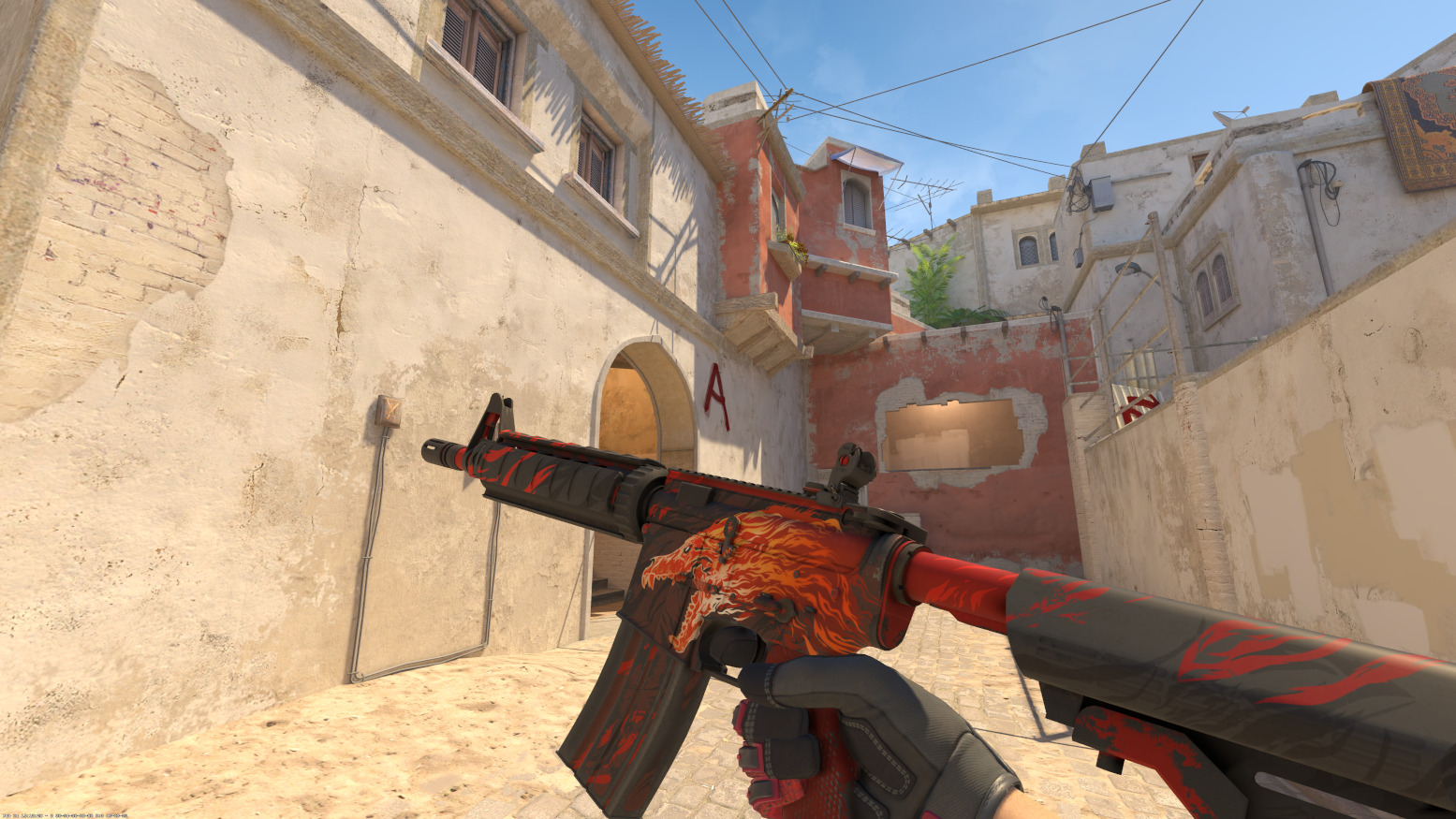
The M4A4 Howl was added to CS:GO on May 1, 2014, as part of the Huntsman Weapon Case. It launched alongside the “Hunt Begins” update. Two Workshop contributors, known as Auzzii and SiC, submitted the design featuring a snarling wolf engulfed in red and black flames. Players loved it immediately. It was bold, aggressive, and looked fantastic on one of the most-used CT rifles in the game.
At the time, you could unbox it like any other Covert skin. Early prices were surprisingly reasonable compared to what you’d see later. We’re talking roughly $20-50 for lower wear versions when the case first dropped. Nothing crazy by today’s standards.
The skin was popular, the case was selling well, and everything seemed normal. That lasted about six weeks.
The Copyright Scandal That Changed Everything
Here’s where it gets messy. The wolf artwork used in the Howl wasn’t original. A DeviantArt artist named CanisAlbus discovered that his “Howling Dawn” design had been stolen by Auzzii and SiC. They’d taken someone else’s art, submitted it to the Steam Workshop as their own, signed the legal agreement confirming it was original work, and started collecting revenue from it.
Once CanisAlbus found out, he filed a DMCA takedown notice with Valve. And Valve did not take it lightly.
On June 11, 2014, Valve published a blog post titled “Respecting Intellectual Property” and laid out exactly what they were doing about it. The Howl and the Howling Dawn sticker (which used the same stolen artwork) were both pulled from circulation. Every other skin that had SiC listed as a contributor was also discontinued. The creators received permanent community bans.
But here’s the part that made the Howl legendary: Valve didn’t just delete existing Howls from people’s inventories. Instead, they redesigned the artwork in-house, updated every existing copy with the new design, and created an entirely new rarity tier called “Contraband.” The Howl was removed from the Huntsman Case permanently, replaced by the M4A4 Desert-Strike. No new Howls would ever enter the game again.
That single decision turned a cool-looking M4A4 skin into the rarest item category in Counter-Strike.
What “Contraband” Actually Means
Contraband isn’t just a fancy label. It means the skin is completely discontinued. You can’t unbox it. You can’t get it from a drop. The only way to get a Howl is to buy one from another player or trade for it. The supply is permanently capped, and it only goes down over time as accounts get banned, abandoned, or lost.
To this day, the M4A4 Howl remains the only Contraband skin in CS2. Valve has had other copyright situations since then (the M4A4 Griffin, the AWP Doodle Lore), but they handled those differently. Griffin got a quiet redesign with no rarity change. Doodle Lore was completely replaced by the AWP Duality. Neither became Contraband.
The community has basically accepted that Valve learned from the economic chaos the Howl caused and decided to never do it again.
The Duplication Exploits
This is the part of the Howl’s history that people talk about less, but it had a real impact on the market. In the earlier days of CS:GO’s trading system, some players figured out ways to exploit Steam Support to duplicate skins. The method involved manipulating trades between accounts, getting flagged for suspicious activity, and then using Steam Support’s ticket system (which was handled by different regional centers) to essentially restore items that had already been traded away, creating a copy in the process.
High-value skins were the obvious targets. The StatTrak Factory New M4A4 Howl with rare stickers was one of the most duplicated items. According to community tracking, a StatTrak FN Howl with 3 Titan Holo Katowice 2014 stickers was duped around 2 times, while a version with 2 Titan Holos was reportedly duped around 40 times. Items that previously had only a handful of copies in existence suddenly had dozens on the market.
Steam Support’s regional structure meant it took a while for the problem to get caught. By the time Valve patched the exploit and improved their systems, the damage was done. It contributed to a noticeable crash in the skin market. Duped Howls are still out there in circulation today, and while Valve doesn’t ban people for owning them, collectors who care about provenance will pay less for a known dupe.
The Price Journey: From $20 to Six Figures
The Howl’s price trajectory is one of the most dramatic in skin trading history.
When it first launched in May 2014, you could pick up lower-condition Howls for around $20-50. Even Factory New versions were accessible. After the Contraband reclassification in June 2014, prices jumped immediately, but they were still nowhere near where they’d end up. StatTrak Minimal Wear versions were going for around $400 shortly after the change.
From there, the price just kept climbing year after year as supply slowly drained and CS:GO’s playerbase kept growing. By 2020, a Chinese collector reportedly paid around $120,000 for a StatTrak Factory New Howl with four iBUYPOWER Katowice 2014 Holo stickers applied. That was a record-breaking deal at the time.
For a “normal” Howl without crazy sticker combos, you’re still looking at roughly $4,000-5,000 for Well-Worn, scaling up to $8,000-13,000+ for Factory New, and $15,000+ for StatTrak Factory New. These are approximations based on third-party market listings, and they fluctuate, so always check current prices before making any moves.
The Original vs. Redesigned Artwork
One detail that sometimes confuses newer players: the Howl you see in-game today is NOT the original stolen artwork. Valve’s in-house team redesigned it after the DMCA. The current version still features a wolf and flames in the same red/black color scheme, but the wolf itself looks different from the CanisAlbus original.
Why the Howl Still Matters
Over a decade later, the M4A4 Howl is still one of the most talked-about skin in CS2. It sits at the intersection of everything that makes the skin economy interesting: community-created content, legal drama, artificial scarcity, collector culture, and absurd amounts of money changing hands over pixels on a gun.
It also set a precedent. After the Howl situation, Valve tightened up their Workshop submission process, and the entire community became more vigilant about calling out stolen artwork. The skin market matured because of this controversy.
Whether you see the Howl as a smart investment, a piece of gaming history, or just a really good-looking M4A4 skin, there’s no denying it earned its spot as one of the most legendary items in Counter-Strike.